
 E-Paper




Why, as a Hindu, I also revere Sikhism
In an age fractured by narrow identities and manufactured hatreds, the message of Guru Nanak offers an indispensable civilisational corrective




Guru Nanak’s 557th birth anniversary (1469-1539) was celebrated last week. I am a Hindu, and have been a student of Hindu philosophy, but I could unhesitatingly be a Sikh too, because Sikhism, to my mind, is a lyrically simplified and compelling reiteration of the highest truths of Advaita Vedanta that is easily comprehensible to the lay person.
Indeed, the mool mantar or fundamental premise of Sikhism is Ik Omkar. There is only one Supreme Being, which like Advaita’s Brahman, is nirankar (formless), akal (timeless), karta purakh (the Creator), agam agochar (beyond thought and invisible), and is Waheguru (wonderous Teacher). The religion emphasises the non-duality of divinity: Ik noor se sab jag upja (From one luminous light, the entire universe arose).
In this one statement, Guru Nanak pole-vaulted above conventional religious orthodoxies. Indeed, his aim was to strip away encrusted dogma and restore the indivisible essence of human dignity. As a boy, when asked to wear the sacred thread (janeu), Nanak asked the priest for a thread spun from compassion, twisted with contentment, and dyed in truth — a thread that neither breaks nor soils. Later, emerging from a mystical immersion in the Kali Bein river at Sultanpur Lodhi, he uttered the revolutionary proclamation that defined his life: “Na ko Hindu, na ko Musalman” (There is neither Hindu nor Muslim, only human beings united in the eyes of the Creator).
Accompanied by his devoted Muslim companion, Bhai Mardana, who played the rabab, Guru Nanak embarked on four epic Udasis — journeys spanning thousands of miles across India, Tibet, Sri Lanka, and West Asia. Everywhere he went, he dismantled superstition with gentle, unforgettable irony. At Hardwar, seeing pilgrims splashing Ganga water toward the rising sun to nourish departed ancestors, Nanak turned around and threw water toward the west, explaining serenely that if their water could reach ancestors in heaven, his would surely reach his thirsty crops in Punjab. Years later, in Mecca, when reproached for sleeping with his feet toward the sacred Kaaba, he softly invited his critic to turn his feet in any direction where the House of God did not exist.
It is no surprise then that the Sikh scriptures refer to Hindu deities like Shiva, Parvati, Rama and Krishna, as also Allah, not for purposes of worship but only to indicate alternative names of that One God. The Guru Granth Sahib, which was compiled by Guru Gobind Singh in 1678 CE, contains the hymns of not only the Sikh Gurus but also the teachings of 13 Hindu Bhakti movements, and that of Sheikh Farid and Kabir.
In the Japji, Guru Nanak dismantles external ostentation in favour of inner awakening: “Sochai soch na hovaee, je sochee lakh vaar” (By mere outer cleansing, the mind is not purified, even if one bathes a hundred thousand times). Instead, he offers a timeless compass for living: “Hukam razai chalna, Nanak likhia naal” (Walk in surrender to the Divine Will). And he grounds spirituality firmly in everyday ethics: “Sachon ore sabh ko, upar sach achar (Truth is higher than everything, but higher still is truthful living). Furthermore, centuries before modern environmentalism, Nanak sacralised nature as the Creator’s living temple: “Pavan guru, paani pita, mata dharat mahat (Air is the guru or teacher, water the father, and the great Earth the mother of all).
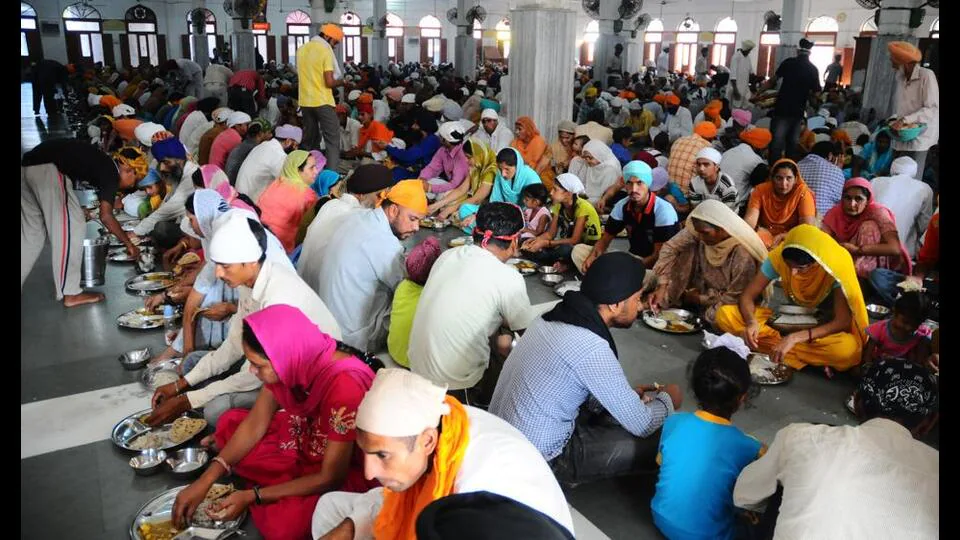
Crucially, Guru Nanak rejected ascetic escapism, anchoring spirituality in a practical, three-pillared social philosophy: Naam japo (meditating on the Divine Name), kirat karo (earning an honest, dignified livelihood through hard work), and vand chhako (sharing one’s earnings selflessly with the needy). This egalitarian ethos came alive in the langar — the community kitchen where kings and paupers sat side by side on the floor (pangat) to share a meal, obliterating centuries of caste untouchability.
I find it deeply peaceful to listen early morning to Shabads — rhymed and truly soulful musical compositions based on 31 classical ragas. These also contain the immortal verse of Kabir: “Avval Allah noor upaya, kudrat ke sab bande; Ek noor te sab jag upjya, kaun bhale ko mande (First, the Divine created the Light, and from that single cosmic Light (Ik Noor) the entire universe arose; who then is good, and who is inferior).
In an age increasingly fractured by narrow identities and manufactured hatreds, the message of Guru Nanak, combining spirituality, service and equality, offers an indispensable civilisational corrective.
Pavan K Varma is an author, diplomat, and former Rajya Sabha MP. The views expressed are personal











