
 E-Paper







Abhishek Jha is Assistant Editor-Data at Hindustan Times. He uses statistical programming to generate newsworthy insights from large datasets. He is part of the team that produces Number Theory, a daily data story feature of the paper’s print edition. Since March 2024, he has been writing Weather Bee, a weekly column for the Hindustan Times website. He is a chemical engineer by training, who specialises in stories related to weather, climate, and the environment. Jha has been at HT since 2018, where he offers data-driven perspective and analysis on politics, environment, weather, climate, economy and society. His work includes data coverage of elections in India and abroad, including the 2019 and 2024 Lok Sabha elections; the disasters and extreme weather resulting from changing climate, such as floods, droughts, heat waves, cold waves, and dwindling snow cap in the Himalayas; the factors that drive poor air quality in northern India; the changing patterns of land use; the Covid-19 pandemic and its impact on labour market conditions; the changing pattern of consumer spending seen in the new consumer spending surveys; and social norms seen in the surveys such as the National Family Health Survey.
Can the world COP its way out of 1.5°C warming? | Number Theory
Antalya COP31 ran overtime as countries ramp up fossil fuel supplies amid West Asia war, raising questions over how to cut emissions and who should pay for it


The 31st Conference of the Parties (COP), a meeting of the countries that adopted the United Nations Framework Convention on Climate Change (UNFCCC) in 1992, was scheduled to end in Antalya on Friday but went into overtime as it has done in the past. This is one of the more ironic COPs in history. The summit’s central goal has always been reducing emissions from burning fossil fuels. But most countries have spent the year trying to increase fossil fuel supply thanks to the supply shock caused by the war in West Asia.

The larger challenge of containing the climate crisis, however, remains unchanged. The near-final draft suggests that Antalya will acknowledge the severity of the crisis, but fail to agree on answers to the questions that matter: how to decrease emissions fast, who will decrease emissions, and who will fund the decline in emissions. This two-part data series will first show why these questions matter at all and then explain why agreement on answers is hard.
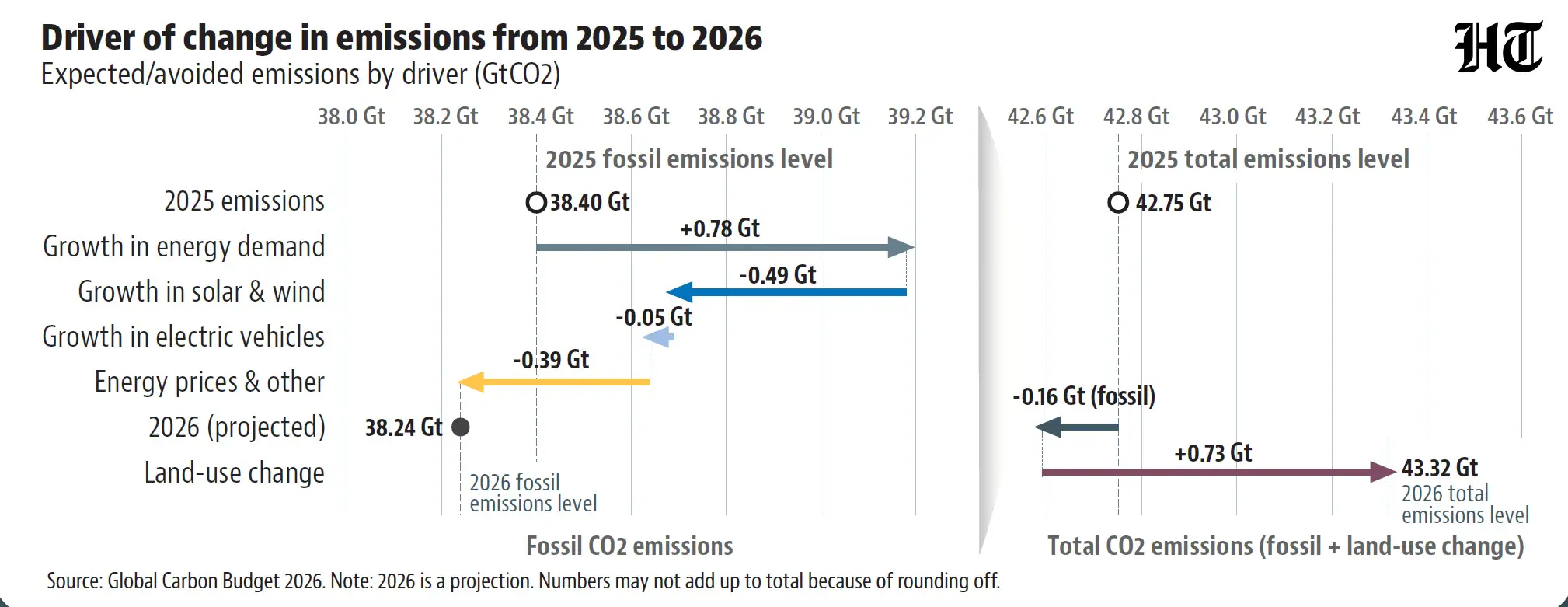
 2026 might see fossil fuel emissions decline for the first time since 2020 due to extra-COP reasonsThe growth of greenhouse gases (GHGs) responsible for global warming happens through two main processes: the burning of fossil fuels, which is increasing annually and has accounted for 90% of emissions in recent years; and through change in Iand use. Estimates for 2026 made by the Global Carbon Project (GCP) suggest that emissions from fossil fuels are expected to decline this year compared to 2025. This will make 2026 one of the rare years since the post-World War II emission boom in which either a fuel supply shock (the first and second oil crisis and the ongoing West Asia war) or a demand shock (the Asian financial crisis, the global financial crisis, and the Covid-19 pandemic) has cut emissions. In other words, despite 30 previous editions of COP, the annual decline in fossil fuel emissions has been largely unrelated to outcomes from the summit. To be sure, the war alone is expected to remove only half of the expected growth in emissions in 2026, with the rest being accounted for by the growth in clean energy and EVs. And even the expected decline in burning fossil fuels is so small that total GHG emissions, including those from changes in land use and land cover, will continue to increase.
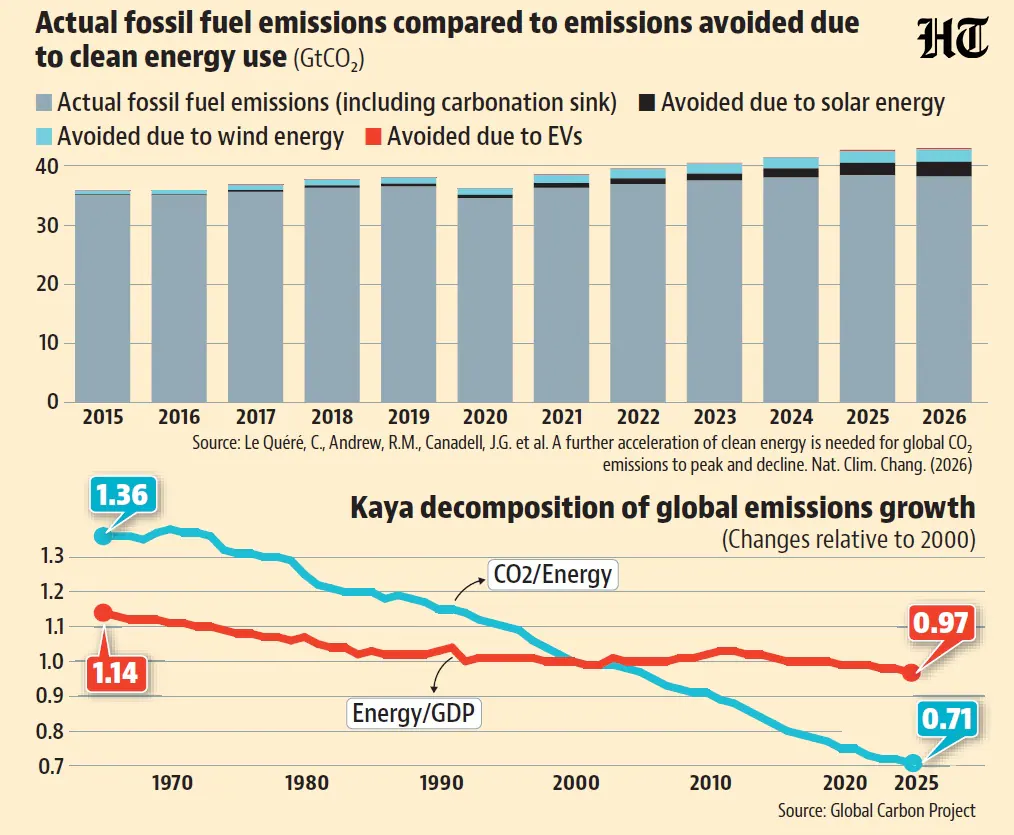
- Clean energy adoption has helped in slowing growth in emissions…Adoption of clean energy and electric vehicles (EVs) has been helping reduce fossil fuel-based emissions progressively. They helped cut expected emissions by 2.3% in 2015, 5% in 2020, and 10.1% in 2025. In 2026, this number is projected to be 11.3%. Not all of this reduction can be attributed to efforts to mitigate carbon emissions, as growing energy efficiency has been bringing down energy required per unit GDP – a trend which predates the global climate accord. However, CO2 emitted per unit energy consumed has only shown a marginal decline very recently, which is why, in a world of economic growth, containing carbon emissions has been a challenge.
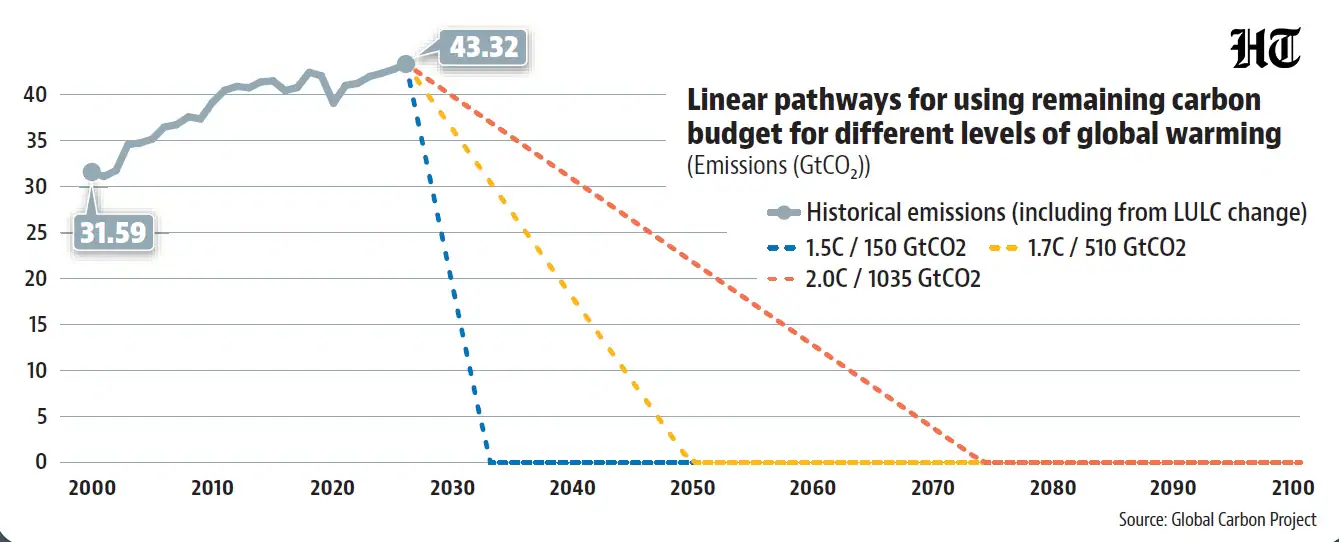
- …but not fast enough for keeping global warming under 1.5°CThe growth in clean energy adoption in the past decade, accompanied with a relative plateau in GHG emissions, paints a hopeful picture. However, this progress is not fast enough. As HT reported on November 16, this year is almost certain to be the second year to record a global temperature deviation of at least 1.5°C from the pre-industrial average, widely accepted as the threshold of a catastrophic climate crisis. This suggests that we are on the verge of breaching that threshold in terms of long-term warming. What will it take to prevent that? For even a 50% chance of preventing long-term warming to 1.5°C, we need to limit emissions from January 2027 to a cumulative 150 GtCO2 or around three years of emissions at 2026 levels. The corresponding numbers for 1.7°C and 2.0°C are 510 GtCO2 and 1035 GtCO2 (12 and 24 years at 2026 levels). All these targets require sharp and consistent reductions in annual emissions and not sporadic declines on account of exogenous factors such as an energy supply shock or a shock to economic growth.
It is because of the urgency of the crisis described above that people look with hope towards COP’s decision. The second-part of this series will show why they are likely to be disappointed.











