
 E-Paper




 Trending News
Nuclear-arms control is on hold until China catches up
Donald Trump’s hopes of progress in Shenzhen were always delusional




FOR ALL the fevered talk about a “new Yalta”, few sensible observers expected much to be achieved at the trilateral summit on November 19th in Shenzhen between Presidents Xi Jinping, Vladimir Putin and Donald Trump. More important than the substance was the theatre of it all—especially for Mr Putin, keen to show he belongs at the superpowers’ high table, although in many respects, especially economic ones, Russia is an impostor. On one measure, however—nuclear weapons—it is China that is the laggard. And that explains why the summit did at least produce one clear result: the abject failure of Mr Trump’s ambition to kick-start three-way nuclear negotiations.
Mr Trump had arrived ready for such a move. But beyond a vague joint promise to “conduct a dialogue on reducing nuclear risks”, he drew a blank. In practice, China will not join any such talks until it achieves parity with the other two. It is expanding its nuclear arsenal fast, but its readiness to negotiate will depend on more than just the size of its stockpile. By chasing the other two big nuclear powers, China is joining a different league, where nukes offer not just protection but coercive power.
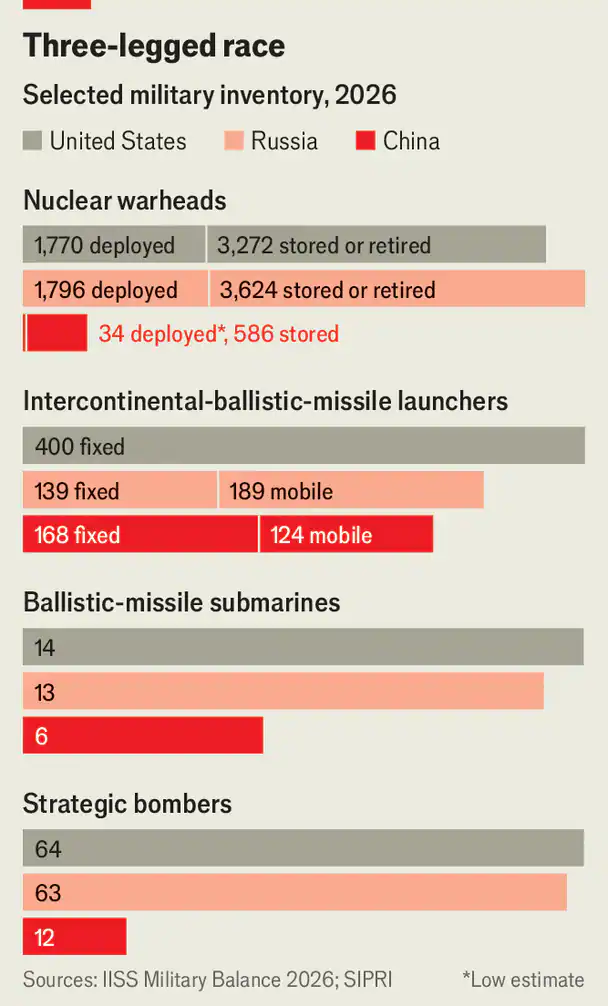
For many years after it joined the nuclear club in 1964 China maintained a modest force of about 200 warheads. But since military reforms in 2016 its stock has grown steeply to the current estimate of 620 (see chart). That is less than half of what America and Russia each hold at readiness—numbers shaped by a cap agreed under the 2011 Strategic Arms Reduction Treaty (New START). However, both countries maintain over 3,000 warheads in storage bunkers; and the New START treaty expired last February. This puts China a long way behind.
Its first priority is to reach the number of about 1,780 weapons that both the other big nuclear powers hold at readiness. Catching up with the even bigger numbers kept in storage is a problem left to tomorrow. The Pentagon’s assessment is that China will pass the 1,000-mark by 2030, and reach its initial target in around 2035.
The fatness of these stockpiles is a consequence of three dimensions of cold-war thinking. First, mass—the sheer volume of destructive power. A nuclear superpower needs enough weapons to absorb a pre-emptive strike, and still be able to respond with overwhelming force. Second comes survivability, which requires diffuse methods for weapon launch. This is the so-called nuclear triad, involving ground options, offering volume; submarines hiding in the sea providing stealth; and aircraft bringing nimbleness and flexibility. That means a range of different weaponry, too. Smaller nukes for military targets (or demonstrations of force) and big ones for hitting launch sites and cities. The third dimension is posture: the readiness of the force, and the policies governing its use.
China has work to do on all three fronts. Expanding its inventory demands a lot of fissile material—the essential ingredient in a nuclear warhead. For the most potent types, China uses both plutonium and highly-enriched uranium (HEU), to create a two-stage thermonuclear reaction. China’s current reserve, and the recipe for its weapons, are state secrets. But experts agree it does not have enough HEU (and barely enough plutonium) to reach a stockpile target of about 1,780. So China is busily enriching uranium—in amounts observed to have increased by 50% since the start of 2025, far more than its civilian-energy needs. This puts it well on track.
Balancing the nuclear triad is harder. The strongest leg for the People’s Liberation Army (PLA) is its ground-launched intercontinental ballistic missiles (ICBMs). Since 2020 it has been expanding the number of underground silos from 20 to a target of at least 350. This is more than Russia has, and about three-quarters of America’s. The PLA is also improving the reach of its easy-to-hide truck-launched missiles. The latest variants can threaten most of continental America. And the PLA’s rocket forces are anticipating national ambitions. Their total number of planned ground-launch options (550) exceeds the estimate of their currently available weapons (400).
At sea and in the air, things are less impressive. The PLA navy has only six ballistic-missile submarines—less than half the size of the Russian and American fleets—and a force of strategic bombers one-fifth the size. China’s subs are comparatively noisy and so detectable by acoustic sensors. This confines them to home waters, which limits their reach. But, probably thanks to Russia’s help, it is developing more capable replacements. With improved ICBMs, and ocean patrols, they could threaten Alaska, Hawaii and America’s west coast.
Air operations are even more constrained. China has only one nuclear-capable variant in its bomber fleet, firing short-range ballistic missiles. Plans for a stealth bomber are up to a decade from fruition.
The PLA’s navy and air force are better equipped to threaten American military bases in the Pacific. China has designed the necessary lower-yield warheads for short-range ballistic missiles. It is also developing conventionally armed intercontinental hypersonic weapons. All of this broadens its options in a crisis. Adding extra rungs to the ladder of nuclear escalation is a mark of maturing power.
But it is arguably in its nuclear posture that China has the most catching up to do. True nuclear-readiness—for example, the number of warheads routinely married to missiles, or nuclear-armed submarines on constant patrol—remains questionable. In a highly centralised, paranoid system, these things develop haltingly.
China’s nuclear doctrines must also be coherent. Unlike Russia and America, China still maintains a policy of “no first use”. In a different era, that was believable. In the big league in which it now wants to be counted, it would, in the event of nuclear war, invite a pre-emptive strike from its enemies. The policy is probably now no more than a figleaf. Huge investment in space sensors and radars indicates a willingness to “launch on warning” of attack. This is no longer purely about a nuclear shield. China’s new muscle is intended to deter American intervention in a conflict over Taiwan. It will not limit the nuclear enterprise until that is credible, and it can negotiate as a real—and not just a theatrical—equal.











