
 E-Paper




Even 1,000 feet below, no water: Solapur farmers’ borewell gamble fails
With borewell drilling proving increasingly futile, farmers are turning to private water tankers to keep their crops alive




Drilling nearly 1,000 feet deep into the ground has failed to bring relief to farmers in drought-stricken Solapur where even borewells dug beyond 650 feet are yielding little or no water. With groundwater reserves rapidly depleting, farmers who have spent lakhs of rupees on deep drilling are watching helplessly as their pomegranate and other high-value crops wither away.
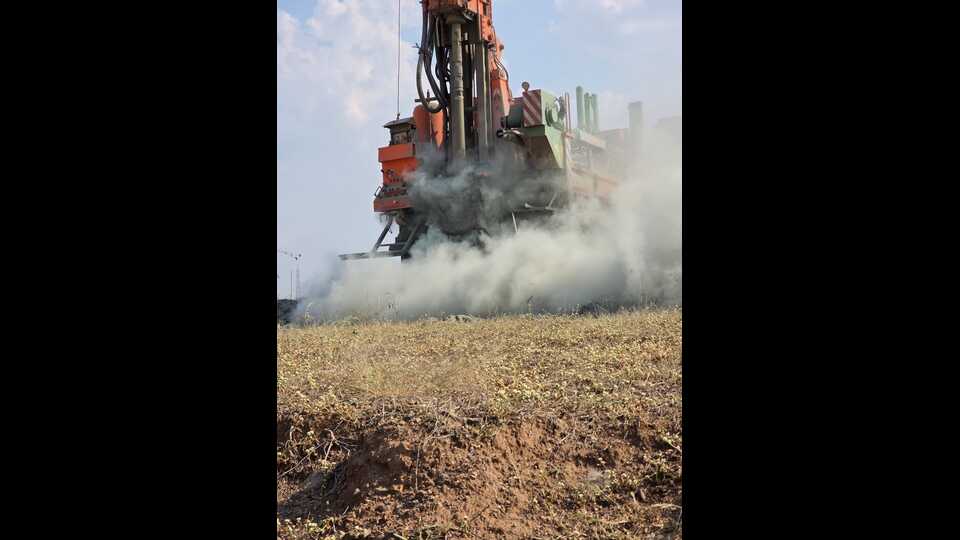
In Junoni village, pomegranate farmer Prakash Patil is staring at losses from his 17-acre orchard despite spending ₹7 lakh on a desperate search for groundwater. In October, Patil hired a local drilling agency to dig three borewells hoping to secure water for irrigation. “Even after drilling beyond 650 feet, two borewells came up completely dry. The third yields barely 1,000 litres of water per day, which is nowhere near enough for 17 acres. I am forced to reserve whatever little water it produces for drinking,” he said.
About 15 km away, Santosh Babar of Manegaon village, spent over ₹2 lakh on drilling a borewell to nearly 1,000 feet in a bid to save his 15-acre pomegranate and capsicum farm but the exercise yielded only a meagre quantity of water insufficient for irrigation. “My entire investment has gone to waste. The water is so little that it serves practically no purpose,” he said.
Patil and Babar are among scores of farmers across Solapur’s 11 talukas who have resorted to increasingly deeper drilling in a desperate attempt to protect their water-intensive crops. But with groundwater levels plunging, district officials estimate that more than 90% of newly-dug borewells are failing to strike water. “Our feedback is that nearly 90 to 100 borewells are being dug across all 11 talukas every day, and almost all are failing,” an official said.
Along with eight districts in Marathwada, Solapur in western Maharashtra is grappling with one of the state’s worst droughts, having recorded a 58% rainfall deficit. According to officials, farmers who have invested heavily in agriculture and horticulture are now spending more money searching for water, even as the chances of finding it diminish with every additional foot of drilling. The crisis is being attributed to years of excessive groundwater extraction when water availability was relatively comfortable, followed by a deficient monsoon that failed to replenish the underground reserves.
Mushtaq Ahmed Shaikh, senior geologist with the state Groundwater Surveys and Development Agency (GSDA) in Solapur, said that the situation is particularly alarming, with groundwater levels declining by more than 11 feet in October alone.
GSDA officials said that in a normal monsoon year, drilling to a depth of around 200 feet is generally sufficient to strike water. However, the present situation is vastly different.
“Given the current groundwater scenario, drilling beyond 200 feet in most cases is a futile exercise. The underground aquifers are severely stressed, and farmers are unlikely to find sustainable water even by going deeper,” another GSDA official said on condition of anonymity.
With borewell drilling proving increasingly futile, farmers are turning to private water tankers to keep their crops alive. Sandeep Kolewale, agriculture assistant in Sangola taluka, said that the rising dependence on tankers is adding to the farmers’ financial burden. “Hiring tankers every day entails huge costs, but farmers have little choice as they are desperate to save their crops and orchards,” he said.
Groundwater stress spreads across Maha
The crisis in Solapur reflects a wider groundwater emergency across Maharashtra. Nearly 86% of the state’s 353 talukas are facing varying degrees of aquifer stress, according to the latest assessment by the GSDA, the technical wing of the state drinking water and sanitation department.
The October survey found that 303 talukas are experiencing rapid groundwater depletion, as compared to 223 in September.
“More than 50% of these talukas are in Marathwada, Amravati and parts of western Maharashtra, including Solapur. We are concerned that more talukas will be added to the list in our next survey over the coming months,” a GSDA official said, requesting anonymity.
State drinking water and sanitation minister Gulabrao Patil told Hindustan Times that the findings point to a rapidly worsening groundwater situation.
“The state government has been constantly appealing to people to use water judiciously, as both groundwater and surface water scarcity will aggravate once the winter ends and temperatures begin to soar,” he said.
GSDA officials said that aquifers are replenished when rainwater percolates through the soil and fractures in underlying rock formations. However, deficient rainfall this year meant that very little water seeped into deeper underground layers.
“Coupled with high temperatures, moisture in the topsoil evaporated before it could percolate downwards and replenish groundwater reserves,” officials said.











