E-Paper




A new book questions who owns the city, celebrates Girangaon’s working-class pride
On November 14, ‘Thasan’ had its “official launch” in Pune: a pointed choice, in a city pulling down its wadas and chawls for towers. A Girangaon novel speaks to every smart city demolishing its own

 Prefer HTon Google


MUMBAI: Marathi novels are usually launched with a lamp, a garland and a speech from a senior writer who has not read the book. Avinash Usha Vasant launched the cover of ‘Thasan’ with a rock song.
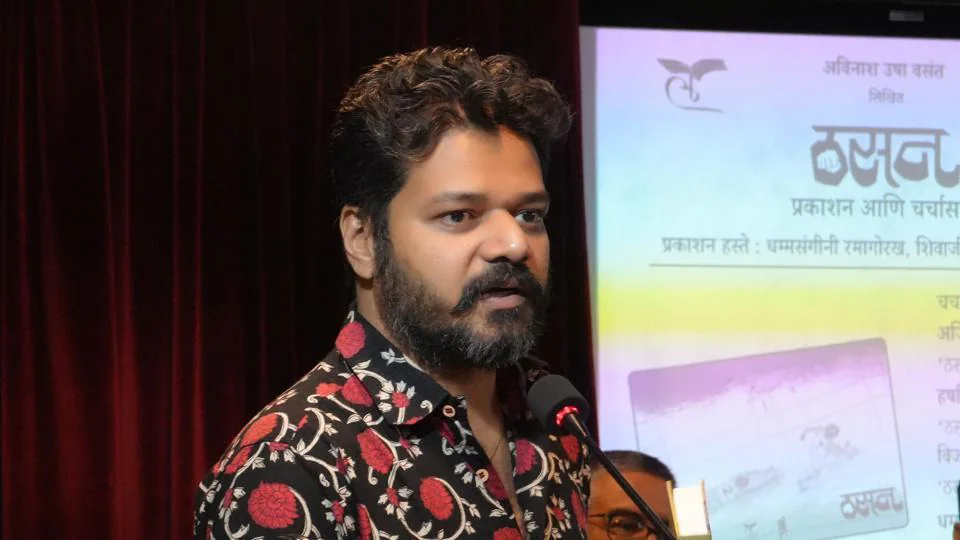
It played before a show of ‘Todi Mill Fantasy’, the landmark play about Girangaon’s mills. Some 200 people heard it and walked out chanting a single word: thasan, thasan.
His first novel, ‘Pateli’, was predicted not to sell 200 copies. It has sold thousands, without a patron, a prize or a publicity budget. Girangaon literature still has the clout to provide the soundtrack to malevolent Mumbai.
On November 14, ‘Thasan’ had its “official launch” in Pune: a pointed choice, in a city pulling down its wadas and chawls for towers. A Girangaon novel speaks to every smart city demolishing its own.
Critics place Avinash in the line of Namdeo Dhasal and Bhau Padhye. But Girangaon, he says, has too often been written as misery and filmed as spectacle. He wants to write it as dignity.
What is Thasan?
Thasan is street lingo: rivalry, a face-off, the itch to go one better than the other fellow. Kader Khan carried it from Kamathipura and Girangaon into Hindi cinema. Avinash uses it in the plural: two boys, one always first, the other always wanting to be; the chawl’s girls fighting for a sliver of public space; chawl culture against the city that looks down on it; old Girangaon against the glass towers on its mill land; and, largest of all, a community against those who exploit it. “It is not linear,” Avinash says. Which is why the novel resists a single heroic protagonist.
‘Thasan’ is set in one Girangaon chawl between 1998 and 2003, when the mills had stopped but the towers had not started. Its boys, Hava and Chemlya, come of age too early, the dream city crashing into their small patch through every screen and billboard. So, they hustle -- jugadu and street-smart -- pushed along by a planetary system of sisters, mothers and neighbours.
Then the names: Hava, Chemlya, Sumdi, Tapad, Chimpat, Ravas. Girls rarely got nicknames, because they were rarely allowed into the public space where nicknames are minted. Even a name is a map of who owns the street.
Who built the city?
Avinash’s premise is one I have held since I sat with mill workers while writing ‘Cotton 56, Polyester 84’: Mumbai was built by labour. Once, he says, the city promised everyone, regardless of caste, religion or gender: come with your two hands and you will not starve. That promise is forgotten. Capital captures common wealth as private value: as rent, land price, “location”. Workers make a neighbourhood worth living in; the developer sells that worth back to the rich. Labour is not merely underpaid. It is erased from the city’s story of itself.
Girangaon gave India its weekly Sunday holiday, and gave Maharashtra much of the Marathi culture it now celebrates, from the public Ganeshotsav to Dahi Handi. Count the Samyukta Maharashtra martyrs who came from the mill lanes.
‘Tashan’s quietest radical move is about women. Hava’s father credits Girangaon to the mool stree, the original woman who ran the khanaval and fed the men who came alone to work the looms. Men built the mills. Women made Girangaon habitable. Avinash writes not another mill history but a history of working-class subculture.
Assertion, not entertainment
‘Thasan’ is a work of assertion politics. For years Girangaon has been flattened into one image: when the mills shut, the boys became gangsters and the girls went on the streets. Avinash blames the writers before Bollywood, pedigreed Marathi writers among them, who chose the thrill of the underworld over the dignity of the wadi and put the Girangaon woman in the dock.
His counter-principle is blunt: “If the savarnas are being entertained, you have gone wrong.” Only the chawl and the basti have their private lives turned into public spectacle: the criminalisation of a social location. Thasan’s narrator knows the suffering is not karma. It is the caste structure.
Thasan with the isms
Thasan’s largest rivalry is with the isms that have hypnotised Mumbai: developmentalism, consumerism, and a smug individualism sold as aspiration. When the mills closed, close to two lakh people left the city. Avinash calls what followed accumulation by dispossession: finance capital parks its surplus in urban land, and Mumbai’s 600 acres of mill land were the perfect vault. A 2001 rule change shrank the share for public housing and open space to a fraction, and the towers rose.
In one mall a mill chimney survives as decoration; the mill worker does not. Redevelopment, Avinash notes drily, has mostly produced vertical chawls with the common toilet moved indoors and the neighbourliness demolished. What is at stake is the right to the city. The same logic now razes hills and mangroves from the Konkan to the third Mumbai. “This is not development,” Avinash says. “These are projects of destruction.”
Avinash recalls that Tukaram’s gatha was drowned in the Indrayani. For the Bahujan writer, documentation is a political act; in a city where capital keeps erasing labour, a novel is a counter-archive. Jyotiba Phule said: don’t argue with theology, open a school. Avinash says: don’t argue with the towers, publish a novel like Thasan.
Ramu Ramanathan is a playwright, poet and journalist

Stay updated with all the Breaking News and Latest News from Mumbai. Click here for comprehensive coverage of top Cities including Bengaluru, Delhi, Hyderabad, and more across India along with Stay informed on the latest happenings in World News.